

Natural Gas
Most Michiganders use natural gas to keep their homes warm in the winter. Learn how Consumers Energy uses thousands of pipeline to get natural gas to your home.
What Cooks, Clean and Keeps You Warm
Natural gas is used to heat more than 80% of homes in Michigan (maybe even yours!), and supplies around 36% of all the energy used in the U.S. Why? Because natural gas is really efficient. How efficient? About 35% of the energy used to generate electricity actually reaches your home. Almost 65% is lost along the way. But 92% of the natural gas produced arrives to your home as useful energy. Ready to boil water for spaghetti. Ready to dry the laundry. And ready to warm your family.
All About Natural Gas
What is Natural Gas?
On a molecular level, it’s made up of two elements: one carbon atom plus four hydrogen atoms. It’s part of the hydrocarbon family!

How is Natural Gas Formed?
Millions of years ago, the remains of plants and animals decayed and built up thick layers. Over time, these layers were buried under silt, sand and rock. Pressure and heat changed some of this organic material into coal, oil and natural gas. In some places, the natural gas moved into large cracks and spaces between layers of overlying rock.
From the Well to Your Home
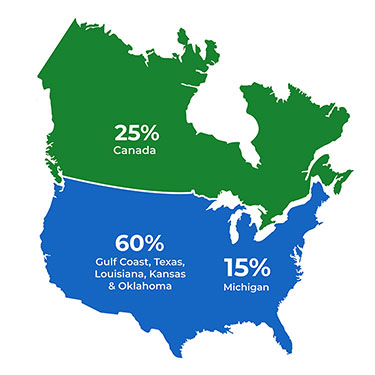
Natural Gas Travels Many Miles to Get to Your Home.
The natural gas that keeps you warm and cooks your food comes from wells all over North America.
- 60% of Natural Gas comes from the Gulf Coast, Texas, Louisiana, Kansas and Oklahoma
- 25% of Natural Gas comes from Canada
- 15% of Natural Gas comes from Michigan

1. Pipelines – Natural Gas Super Highways
We buy 100% of the natural gas we need. It comes to Michigan by underground pipelines called transmission lines. Transmission lines are like the interstate highway for natural gas, and distribution lines are like the roads and streets. Huge compressors keep the natural gas moving a long way until it can be stored.

2: Storage Rocks!
We store natural gas in 15 underground storage fields. But this isn’t just any old storage closet. They’re natural porous rock formations that hold 151 billion cubic feet of natural gas much like a sponge holds water.

3: Prepping for Delivery
When the natural gas is needed, we pump it out from one of 15 storage fields to “city gates.” The pressure is reduced so that it can travel safely from transmission pipelines to distribution pipelines. You can’t smell natural gas, so we add a stinky chemical called mercaptan, so you can tell if there’s a leak.

4: Taking It Home
Transmission lines do all the long distance work, bringing natural gas to Michigan from as far west as Texas. 27,169 miles of distribution lines pick up where transmission lines end, bringing natural gas to service lines that connect to your home.
 Ask CE Watts
Consumers Energy may retain a copy of chat communication.